For clients
- Redbook retail sales index
One of the easiest, but extremely effective ways to evaluate the current state of retail economy in a country is based upon the volume of items sold by retail organizations. The information collected from 9 000 shops of the network Redbook allows to achieve the clear picture of consumer demand in a country and evaluate the dynamics of consumer´s preferences regarding the time of the year, days of the week, holidays and other events.
About the index.
Redbook index is calculated by a branch of the network called Redbook Research Inc and is published every week, on Thursday. In other words, the index is some kind of review o retail sales done by the network’s branches allowing to find out the tendencies of retail sales. For own convenience, it is divided into the following categories:
-
Clothes
-
Furniture
-
Drugs (pharmacy)
-
Sections
-
Goods on sale
-
Etc
The results of the research powered by Redbook Research Inc. are published since 1964 which grants an enormous analytical base regarding the consumer demand of the whole country.
How to interpret the data extracted from Redbook?
Knowing how do the data on consumer demand change at a certain timeframe, one may draw certain conclusions about private income of the population. This references to employment rate allowing to evaluate the volume of production being stored etc.
It is not exactly that Redbook index makes a significant influence on financial market and its participants, but it often accompanies some serious market changes. One should keep in mind the traditional days of sales, pre-holiday discounts, and an increased demand during natural disasters etc. At “Black Friday”, famous for its discounts, customers buy almost everything they see. At such occasions, the indicator Redbook is studied extremely thoroughly by the experts all over the world.
Not only the biggest players of forex market pay extra attention to it, but American financial experts also. The consumers’ customs change in accordance with the index influence the business cycle, escalation and thus the establishment of optimum interest rates by the main financial regulators of the country.
-
- Personal Income Indicator
The volume of one´s personal income is different from salary in the way that the first one includes all the possible sources of money. In some cases the sum differs a lot, thus making their purchasing power analysis way more difficult. Real Earnings indicator is a narrow case, the data collected from the registered entities, while Personal Income is a general case, which includes not only salary and official income, but government aid and other sources.
What are the data sources?
Traders get information about Personal Income from Economical Analysis Bureau’s specialists the month proceeding after the fiscal month. Since this indicator is extremely important for strategy build-up, one’s got to clearly know at what exact time it is published — 9:30 EET (Eastern Standard Time) is the time when official reports appear on the Bureau’s web-site, and at Bloomberg’s, Thomas Reuters and others several minutes later.
How to interpret the Personal Income data?
Following the dynamics of personal income volume allows drawing certain conclusions. A growth of the indicator tells us about an increase in consumers’ customs leading to an increase in the amount of goods obtained. All of the mentioned above positively affects the county’s currency, but if the data revealed in the report shows no growth, but a decrease, one shall expect nothing but a negative scenario.
Personal Income Indicator is an important variable in every prognosis’ formula, though traders notice insignificant influence on the market. But either way, Personal Income is the best preceding indicator which reflects consumer costs and accordingly retail sales and escalation expectations.
- Existing Home Sales — Secondary Realty Market Indicator
American existing home sales is a field of domestic economics which is paid extra attention to by financial experts, bankers and, of course, traders. This is understandable, since the last global economical crises started particularly with severe problems with realty market.
The main trait of American realty consists in comparatively small share of new houses being built (and sold). Citizens normally buy and sell houses on secondary market, but each house is obligatory renewed before the sale.
Secondary Market Indicator
The number of sell-buy deals on secondary realty market — one of the clearest indicators reflecting the state of the mentioned field. That’s why it is paid extra attention to, since it shows the amount of re-sold houses per month. This indicator is more important than new home sales.
When is it published?
A specific trait of this indicator is it’s period of publication — per year. Each numeral collected by the census bureau is multiplied by 12. You may find the current report on the Bureau’s web-site (or some other news agency) on the 20th of each month following the financial month. The data regarding sold houses is published at 11 O’clock EST.
How does the indicator affect financial market?
The field of American realty is attractive, since it opens some new employment opportunities. These are representatives of building field, who repair the old houses, bank accountants who permit or reject loans and the whole army of brokers who are in charge for execution of corresponding transactions. It is obvious that if Existing Home Sales turns out to higher than expected, it shall have positive effect on the market, an increase in sales also increases labor demand.
Along with the mentioned, this indicator sometimes isn’t correctly analyzed by traders while studying its dynamics. The “problem” is in different price levels for secondary buildings. In other words, if the general volume for financial month has fallen it shall be extremely important to study the dynamics in “cheap”, “middle” and “expensive” price level segments. Thus there was a situation in 2013 when Existing Home Sales hadn’t made it to the prognosis level, but the amount of deals in “expensive” segment skyrocketed. This factor almost neutralized the effect that general sales volume produced when it has fallen.
- ISM Services Index
This index is characterized by an extreme influence on the market and neither traders, nor market analysists and financial experts leave it out in the cold. The index of business activity in the field of services is also that important, since its indicator is the result of public surveys conducted among specialists who find themselves in the amidst of the market and who see it from the inside and participate in it.
The monthly survey in Supply Services is conducted by the Institute for Supply Management (ISM). 400 surveyed are the representatives of different fields of business (finance, life and property insurance, sales, education, real estate, etc). They are asked about the current business conditions, volumes of orders, price levels, product stock levels, etc. The result of the survey is reflected in percentage and subdivided accordingly.
When is it published?
The report on ISM is published every 3rd day of the month proceeding the financial month. The exact time is 10.00 EET (Eastern European Time). Traders may find the report on the ISM web-site — www.instituteforsupplymanagement.org or in feeds of such news agencies as Bloomberg, Thomas Reuters and others.
Influence of ISM on the market
Much does the business sector know about all the changes that happen inside the market. Specialists in Forex all as one call Supply Managers the connoisseurs of the country’s economy, prospects and expectations. As a result ISM Services Index is considered to be a most accurate leading index of country’s economic health.
- What is Forex trading?
Everyone has heard about the fantastic possibilities provided by Forex: that it means high income, low initial deposit, availability of various trading-facilitating software, absence of intermediaries and thus, of high commissions that eat into the profits, etc. Let's consider all this item by item.
Forex is an international currency market where major world currencies are traded. Anyone can become a trader and make money in this market. The main currencies traded on it are US dollar, euro, Japanese yen and British pound.
What is the work schedule of this market?
Forex is open for trading around the clock, five days a week from Monday to Friday, closing only on weekends and major holidays, such as Christmas and Easter.
How is money made?
Everything is very simple: you have to buy currency at a lower price, wait and then sell it at a higher price. Let’s suppose that the quotation of the euro to dollar currency pair (EURUSD) is 1.1226, and the trader believes that the rate will grow in the next few hours or days. Thus, he buys euros for dollars, and if the quotation goes up to, let’s say, 1.1296, he can conduct the reverse operation: sell euros and buy dollars.
As we can see, the difference between the purchase and sale price is 0.0070 or 70 points, which are called thousandths or PIP (point in percentage). Since the trader buys not one but 10,000 euros at once, he earns $70.
What to do if the exchange rate is going down?
If a trader believes that the exchange rate will fall, he can first sell, for example, the same 10,000 euros, and then buy them back. The main thing is to make this operation profitable, and thus, every PIP of the rate decrease will translate into one dollar of profit.
Fluctuations of exchange rates are based on fundamental principles, including the strength of the economy and changes in interest rates; yet, political and economic news, events elsewhere in the world or neighboring countries can affect these fluctuations as well. To profit from these changes, the trader needs to either own extensive amount of funds or use credit leverage. When using the latter, even small amount of a few hundred or a thousand dollars can grow 100-, 200- or 400-fold.
With only 1000 US dollars, you can use credit leveraging, for example, 1 to 50 or 1 to 100, to get very large profits within a short period of time. Let's say, the exchange rate of the peso against the dollar has changed from 19.20 to 19.60, i.e., the difference is 0.40. With a leverage of 1 to 50, your earnings with an investment of one thousand dollars will increase 50 times, from 400 pesos to 20,000 pesos. On the other hand, if the trader’s estimation of the direction of the rate change proves to be wrong, he will lose the lion share of the deposit amount with even the slightest fluctuation.
Where can I get 1,000,000 pesos? I don’t have so much money at my disposal
This issue can be solved by using leveraging. If you have funds sufficient for a small security deposit, leveraging will enable you to obtain the amount of funds that is several times larger: the broker will lend you this amount, albeit for a short time and only for investing it in financial markets. With about 1,000 US dollars at a 1-to-50 leverage you will be able to use $50,000 (about 1 million pesos); and the higher the leverage is, the greater the amount of funds will be, meaning that even a 1 point change in the exchange rate will bring you tens and hundreds dollars of profit if your prediction of the direction of price movement has been correct.
All this is true: you can indeed trade at any time convenient for you from almost any place with access to the Internet, getting high profits from small investments. However, you always need to remember the risks involved and understand that Forex trading may not be suitable for everyone.
What are the Forex risks?
The main risk of trading in the Forex market is the use of leveraging. Leveraging will multiply your profits manifold provided the rate moves in the direction you have predicted, but it can also cause losses as quickly if your prediction proves to be incorrect. Statistics show that most Forex traders lose their investment, but it is possible to reduce the risk.
To reduce risk, you must develop a trading strategy and strictly follow it, as well as to be determined and non-greedy. A trader must keep learning, be able to extract information from the news, know how to analyze it, and anticipate possible changes in the exchange rates. Technical analysis and trading robots that reduce errors can be of great help. You should also avoid using the entire deposit or maximum leverage for trading.
How safe is Forex trading?
The Forex market is global and operates 24 hours a day, 5 days a week; therefore, no one controls or regulates it. Forex is not under the control of, say, the Mexican CNBV or the American SEC. However, brokers who provide trading services in this market are issued licenses and being controlled by the financial regulators of the countries in which they are registered.
Often, advertising for the services of Forex brokers does not disclose all the risks that accompany currency trading.
For example:
Forex trading is conducted round the clock and you can earn money in your free time.
Indeed, you can conduct Forex trading at any time and in any convenient place, but this doesn’t mean that you can earn at any time. The choice of the moment of opening or closing a transaction is very important, and for this you will have to study the exchange rate charts, follow the news and wait for the best moment for buying and selling a certain currency pair. This moment does not necessarily coincide with your free time. If you really want to make good profit on Forex, you need to make it your full-time job.
Some people argue that Forex trading is the easiest and fastest way to increase income.
If everything were that simple, everyone would be making money on Forex, but this is not so. In financial markets, the profit of one trader is, as a rule, derived from the losses of other traders. At that, it is the inexperienced traders who most often lose their investments.
Risks in the foreign exchange market are high, and financial advisers recommend Forex to major investors who already have sufficient trading experience, a good understanding of both the macroeconomic and political situation and have the ability to diversify their investments.
- What is NDD (No Dealing Desk)?
Non Dealing Desk (NDD) is a technology of order execution without the participation of the Dealing Desk. With NDD processing, the client's orders are automatically executed directly at the best available prices of liquidity providers, bypassing the Dealing Desk.
- Non-market quotes (Spikes,Off-quotes)
A spike is a non-market quotation. It may be represented in one of the following ways:
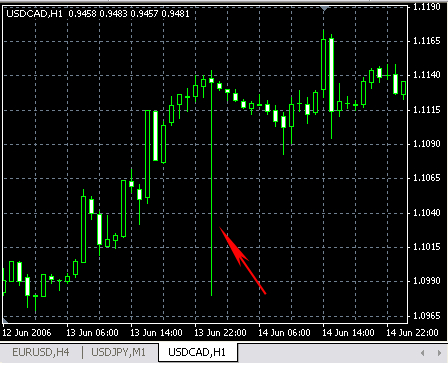
A non-market quote is a quote that complies with each of the below criteria:
- Existence of a considerable gap;
- The price returns to it’s original values within a short period of time generating a gap;
- Absence of sustainable price dynamics before this quote appeared;
- Absence of macroeconomic events or corporate pieces of news influencing the instrument’s quotes considerably.
Non-market quotes usually are sent to a broker via informational systems. The major reasons for that are:
- Technical error.
- A singular deal, often a mistaken one, registered in the informational system.
- Considerable momentary spread widening or unilateral changes in the BID or ASK levels.
Example 1
One of the sellers placed a lot at a price way lower than the current one (e.g. by mistake). One of the buyers reacted to that immediately and bought the lot. Consequently nobody can place a deal at the same price, but the deal was registered and got to the informational system. The non-market quotes on do not get executed on live accounts and if they do, they are obligatorily annulled; the spike consequently gets deleted from the quotes archive. Such deals do not get annulled on the demo accounts.
Example 2
On a low liquidity market in the period between 23.00 EET and 04.00 EET, in the trading system of a large liquidity provider, there would be a high volume deal widening the spread 10 times for a short period. The positions closed due to that case are recovered if applicable, or a client gets a corresponding compensation.
- Deleting an Account in the FIBO Drive Application
Log in using your account details or register a new account.
In the application menu, select the 'Complaints' section. In this section, press the 'Create' button: a dialog with a complaint form will appear. Choose the complaint topic 'Deleting a personal account'. Fill it out and submit.
Before deleting your personal account, you need to:
- Close all open positions on trading accounts and withdraw invested funds from PAMM accounts.
- Withdraw the remaining funds from the trading account using the methods chosen to make the deposit.
- Close all previously opened trading accounts, including Demo accounts, PAMM accounts, and cTrader Copy accounts.
- If you are an IB partner, submit a request to terminate the Agency Agreement.
- Submit a request to delete your personal account. A representative from the Company's customer service department may contact you to confirm your request.
After your personal account is deleted, all your personal data will be removed from the Company's server. The account cannot be restored.
You can ask any questions that arise in the online chat.